Vietnam War Overview Chapter 5

Vietnam War Overview Chapter 5

1968–1969: Turning Point Tet Offensive and Its Aftermath On January 30, 1968, North Vietnamese and Viet Cong forces launched the Tet Offensive: a massive, coordinated attack on dozens of cities and towns across South Vietnam, including major population centers.
Although militarily costly for the North (with very high casualty rates), the Tet Offensive shocked the world, especially audiences in the United States, by showing that communist forces could strike anywhere at will. Public perception of the war shifted dramatically. One of the war’s fiercest confrontations was the Battle of Khe Sanh (Jan–July 1968), where U.S. Marines and South Vietnamese forces held out under siege. The siege was eventually lifted, but U.S. forces subsequently withdrew from Khe Sanh in July, a milestone in shifting tactics. In early 1969, there were further attacks, sometimes dubbed “Tet 1969” by communist forces near Saigon and Da Nang, though these were less ambitious and quickly repelled. Significance: The period showed a shift. The war was no longer viewed as a limited guerrilla conflict; it had become a protracted, large-scale war with rising human costs. Public support (especially in the U.S.) began to erode.

1970–1972: “Vietnamization,” U.S. Withdrawal Begins

Large-scale Military Offensives, as U.S. leaders sought to reduce American casualties and presence, the effort of “Vietnamization” attempted to transfer combat responsibilities to the South Vietnamese military (the Army of the Republic of Vietnam, ARVN). This process ramped up over these years.
Meanwhile, U.S. military operations continued but with shifting focus. For example, in 1969, the last major U.S. marine offensive, Operation Dewey Canyon, targeted PAVN forces in the A Shau and Song Đa Krông valleys. By 1972, conventional large-scale fighting resumed under the initiative of North Vietnam. The Easter Offensive (March–October 1972) saw tens of thousands of regular North Vietnamese army troops, supported by armor and heavy weapons, attack across multiple fronts in South Vietnam.
Although ARVN defenders (with U.S. aerial and logistical support) managed to halt or blunt many of these assaults, the Easter Offensive underscored that the war had fundamentally shifted: from guerrilla warfare to large, organized conventional battles. 1973: Paris Peace Accords U.S. Exit (But War Not Over).
On January 27, 1973, representatives from North Vietnam, South Vietnam, the U.S., and allied parties signed the Paris Peace Accords, officially calling for a ceasefire and an orderly U.S. troop withdrawal. By March 29, 1973, the last U.S. combat troops left Vietnam. Some 58,000 U.S. servicemen had died over the course of the war.
Though direct U.S. involvement ended, the war between North and South Vietnamese forces continued. ARVN remained heavily reliant on U.S. aid and materiel, but with diminishing support, the balance was fragile.

1974–1975: Collapse of South Vietnam, Fall of Saigon, and War’s End

With U.S. support gone, North Vietnamese forces grew more aggressive. From 1974–1975, they launched a series of successful campaigns that routed South Vietnamese defenses, captured territory rapidly, and destabilized the South. (For example, the final offensives toward Saigon.)
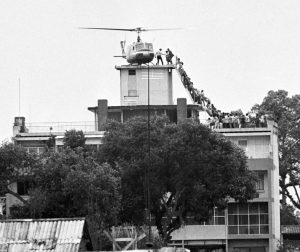
On April 29, 1975, the evacuation of American personnel and many South Vietnamese began in what was called Operation Frequent Wind, a chaotic airlift as enemy tanks closed in on the capital. Early on April 30, 1975, North Vietnamese troops entered Saigon, and the South Vietnamese government surrendered unconditionally.
This marked the end of the Vietnam War and the beginning of reunified control by the North. Aftermath: The war caused enormous loss of life among soldiers and civilians and left deep social, economic, and political scars. South Vietnam ceased to exist; the country was eventually reunified as the Socialist Republic of Vietnam.